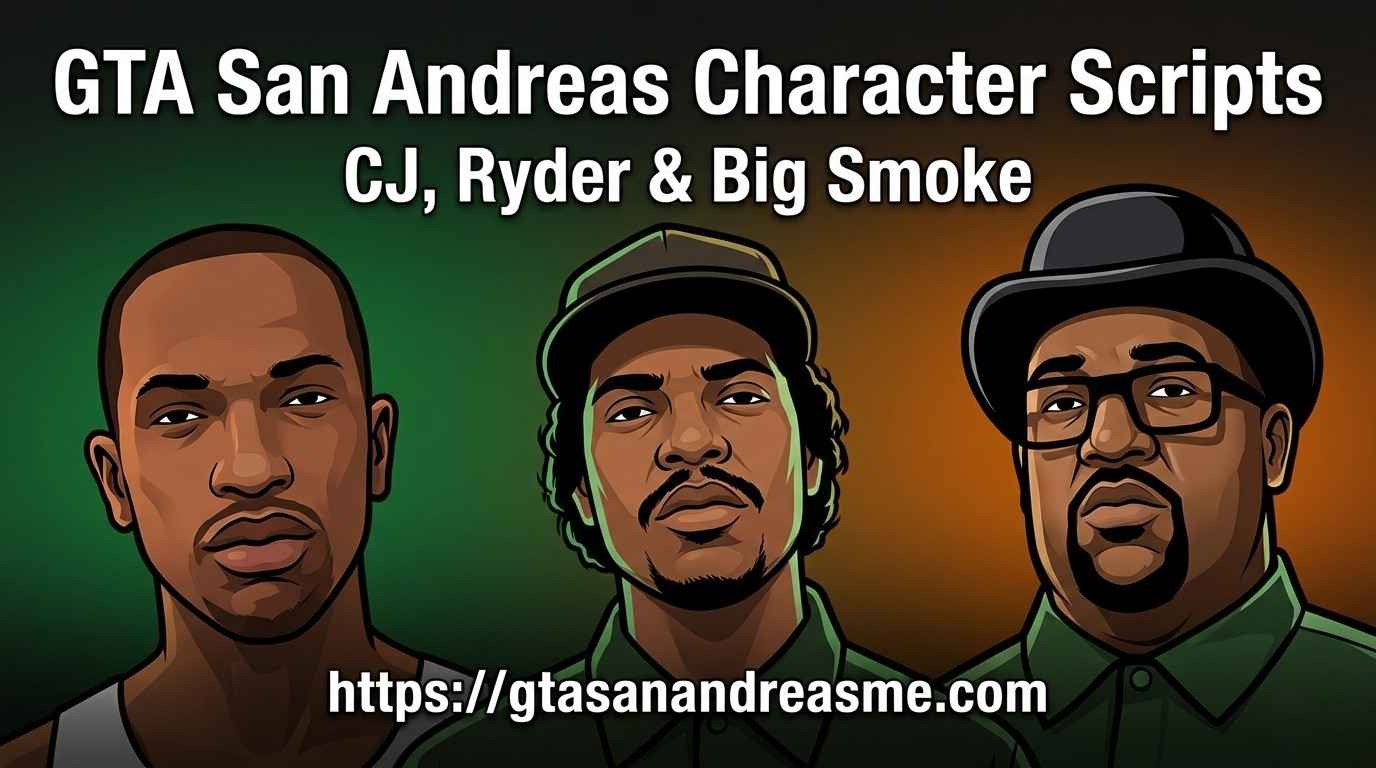
GTA San Andreas Character Scripts Carl Johnson, Ryder, and Big Smoke!
Grand Theft Auto: San Andreas, released in 2004 by Rockstar North, is widely considered one of the greatest video games ever made. At the heart of its success is a cast of unforgettable characters whose scripts, dialogue, and story arcs carry the entire emotional weight of the game. Three characters stand above all others in importance: Carl “CJ” Johnson, Lance “Ryder” Wilson, and Melvin “Big Smoke” Harris. Together, they form the core of the Grove Street Families trio whose friendships, betrayals, and ambitions drive the narrative from the very first scene to the explosive finale.
This guide covers the full character scripts, background, personality, key mission dialogue, iconic quotes, and story arcs for CJ, Ryder, and Big Smoke. Whether you are revisiting San Andreas for nostalgia or exploring its storytelling for the first time, this breakdown gives you everything you need to understand what makes these three characters so enduring across two decades of gaming history.
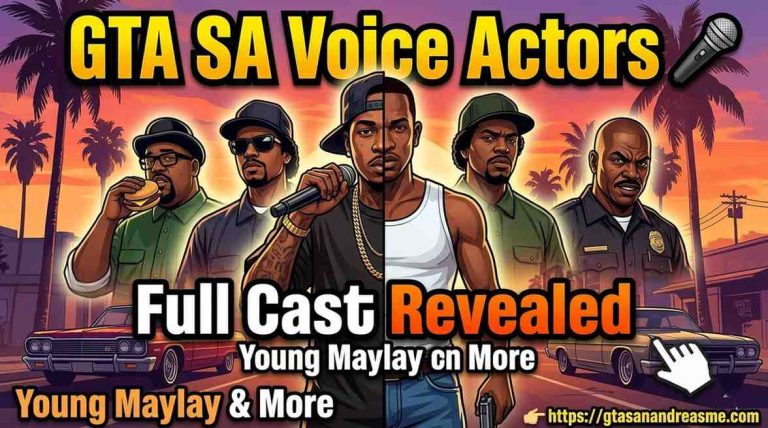
| Character | Real Name | Voice Actor |
| CJ | Carl Johnson | Young Maylay |
| Ryder | Lance Wilson | MC Eiht |
| Big Smoke | Melvin Harris | Clifton Powell |
Carl “CJ” Johnson: The Protagonist
Who Is CJ in GTA San Andreas?
Carl Johnson, universally known as CJ, is the playable protagonist of Grand Theft Auto: San Andreas. Born and raised in the crime-ridden Ganton neighborhood of Los Santos in 1968, CJ is the second-in-command of the Grove Street Families, a street gang led by his older brother Sean “Sweet” Johnson. He spent five years in Liberty City after the death of his younger brother Brian, during which he did petty crime work for Joey Leone. He returns to Los Santos in 1992 after learning his mother, Beverly Johnson, has been murdered in a drive-by shooting.
Unlike the protagonists who came before him in the Grand Theft Auto series, CJ was written with a conscience. He grieves. He questions. He cares about his family in a way that Tommy Vercetti and Claude Stone never did. Executive producer Sam Houser deliberately sought an unknown actor to voice the character, feeling that celebrity casting would make CJ feel less grounded. He found that person in Young Maylay, a rapper from Los Angeles who brought an autobiographical authenticity to every line.
CJ Character Bio and Background
Full Name: Carl Johnson
Nickname: CJ
Born: 1968, Los Santos, San Andreas (Ganton)
Gang Affiliation: Grove Street Families (second-in-command)
Voice Actor: Young Maylay
Appearance: GTA San Andreas (2004), The Definitive Edition (2021)
Family: Sweet Johnson (brother), Kendl Johnson (sister), Brian Johnson (deceased brother), Beverly Johnson (deceased mother)
CJ grew up without a father in a household held together by his mother Beverly and older brother Sweet. When Brian died under circumstances that partially implicated Carl in the gang’s eyes, CJ fled to Liberty City, leaving behind his family and gang obligations. When Beverly is killed five years later, CJ is forced to confront everything he ran away from. He is immediately picked up by corrupt C.R.A.S.H. officers Frank Tenpenny and Eddie Pulaski at Los Santos Airport and framed for the murder of Officer Pendlebury. This opening sequence immediately establishes CJ as a man trapped between systems designed to keep him down.
CJ has over 7,700 lines of dialogue in San Andreas, more than 3,500 in cutscenes and over 4,200 spoken in the open world. DJ Pooh, who co-wrote the script, described CJ as comparable to Tupac Shakur: fiercely dedicated to family but capable of becoming cold-blooded when the situation demands it. The development team aimed for him to be the most human character Rockstar had ever built.
CJ Personality and Character Traits
CJ occupies a rare space in video game history as a protagonist with genuine moral complexity. He commits crimes, participates in gang warfare, and works for corrupt government agents, yet throughout all of it, players consistently read him as fundamentally decent. He saved Madd Dogg’s life during a suicide attempt, showing concern that went far beyond the mission parameters. He remained protective of his sister Kendl even when it created tension with Sweet. He expressed visible disgust at the crack cocaine trade destroying his neighborhood.
Game Informer’s Matt Helgeson wrote that CJ “could have easily been another gangster stereotype, but by the end of San Andreas we see CJ as a flawed, but ultimately good man who did the best he could in the worst of circumstances.” Official U.S. Play Station Magazine called him “possibly one of the most well-developed and believable video game characters ever made.” In 2011, readers of the Guinness World Records Gamer Edition voted CJ the 22nd greatest video game character of all time.
He is pragmatic, quick-witted, and capable of dark humor in difficult situations. He can be inappropriately funny toward women out of frustration, and his open-world commentary reveals a man who notices absurdity even in the middle of chaos. But underneath the jokes is someone who carries the weight of his community’s suffering personally. His arc from exile to redemption is genuine because his failures and growth are written to feel earned rather than assigned.
CJ Physical Appearance and Customization
One of the most celebrated innovations San Andreas introduced was the ability to physically customize CJ. His appearance, weight, muscle mass, hairstyle, clothing, and tattoos all respond to player choices throughout the game. Eating regularly and not exercising causes CJ to gain weight; maintaining a diet and working out builds visible muscle. This system meant that players’ CJ could look radically different from anyone else’s, which deepened the feeling of personal investment in the character.
The base appearance of CJ is modeled on Young Maylay himself. In the Definitive Edition remaster, CJ’s facial model was updated while keeping his foundational design intact. His default look includes a white tank top, dark jeans, and white trainers, though players can dress him in everything from Prolaps sportswear to sharp suits depending on which district or mission requires it.
CJ Story Arc: From Exile to Empire
The story of CJ in San Andreas unfolds across three major geographic phases. In Los Santos, CJ rebuilds relationships with his estranged brother Sweet, earns back trust from fellow Grove Street members, and begins uncovering the truth behind his mother’s murder. Missions like Tagging Up Turf, Nines and AKs, and Drive-Thru establish the tone of street-level struggle before the stakes escalate.
After being exiled from Los Santos by Tenpenny, CJ is forced to operate in San Fierro and Las Venturas, where he builds a legitimate business empire. He acquires a car garage, forms alliances with the Triads under Wu Zi Mu, infiltrates the Loco Syndicate drug operation, and eventually gains shares in the Four Dragons Casino. This phase of the game reveals CJ’s remarkable adaptability. He learns to fly, runs a casino, and navigates intricate criminal politics far removed from the Ganton streets where he started.
The final act returns CJ to Los Santos during the riots that follow Tenpenny’s acquittal. He storms Big Smoke’s crack palace, confronts his former friend, and then pursues Tenpenny in the game’s climactic chase. The ending places CJ at the top of Los Santos’s criminal hierarchy, wealthy, connected, and surrounded by family. He steps outside the Johnson House and tells everyone he is going to see what is happening on the block, a moment that perfectly closes his journey from reluctant returnee to undisputed king.
Key CJ Missions with Script Dialogue
Mission: Big Smoke (Opening Mission)
CJ arrives at the Johnson House on Grove Street and finds his childhood home empty except for a photograph of his mother. Big Smoke enters from the kitchen wielding a baseball bat, convinced there is a burglar. The exchange that follows is one of the game’s most celebrated openings.
Big Smoke: You picked the wrong house, fool!
CJ: Big Smoke! It’s me, Carl! Chill, chill!
Big Smoke: CJ? Aaaooooww my dog! Whassup? Ha ha ha ha!
Following the reunion, CJ expresses grief over his mother’s death. Smoke responds with scriptural language and philosophical comfort, setting up his character as someone who presents himself as wise and caring, even though the player will later learn this warmth masked calculated deception. The two drive to the cemetery where Sweet, Ryder, and Kendl are waiting.
Mission: Sweet and Kendl (Cemetery Scene)
The reunion at the cemetery exposes the fractures within the Johnson family. Sweet greets CJ coldly, immediately blaming him for abandoning the family after Brian’s death. The Ballas attack during the scene, destroying Smoke’s car, and the four friends escape on BMX bicycles. The script here establishes the dynamic that will drive the next several hours: CJ trying to prove himself, Sweet skeptical but protective, Ryder loud and dismissive, Smoke playing the diplomatic peacemaker.
Sweet: That’s another funeral you ran away from, fool. Just like Brian’s.
CJ: Hey, she was my Momma too.
Sweet: Not for the past 5 years she wasn’t.
Mission: The Green Sabre (The Betrayal Revealed)
The pivotal moment of the entire game comes when CJ and Cesar Vialpando stake out a garage and witness Big Smoke and Ryder meeting with Ballas gang members and C.R.A.S.H. officers. The green Sabre present at the meeting is the same vehicle used in Beverly Johnson’s murder. This silent, photographic revelation is more devastating than any confrontational dialogue could be because it confirms what the subtle signs had been hinting at throughout the Los Santos chapter: the two men CJ trusted most had been working against his family all along. Immediately afterward, Sweet is ambushed at Glen Park and taken to prison while Carl is exiled from the city by Tenpenny.
Mission: End of the Line (Final Confrontation)
The final mission of San Andreas begins with CJ storming through multiple floors of Big Smoke’s crack palace, fighting through hired guards and drug dealers. After killing Smoke, Tenpenny appears and takes the drug money before a wounded Smoke dies. Tenpenny then flees in a fire truck. Sweet and CJ pursue him through the riot-torn streets of Los Santos in one of the most cinematic chase sequences in gaming history.
CJ: It’s over, Tenpenny.
Tenpenny: For you, maybe. I’m just getting started.
The chase ends when Tenpenny’s fire truck crashes off the bridge above Grove Street, and the dying officer is surrounded by people he tormented throughout the game. The imagery is deliberate: Tenpenny, the corrupt authority figure who claimed to be cleaning up the city, dies on Grove Street itself, watched over by the community he destroyed.
Iconic CJ Quotes
“Ah shit, here we go again.” (Opening line of the game)
“Grove Street. Home. At least it was before I fucked everything up.”
“I HATE GRAVITY!” (When falling from a great height)
“Are you a professional moron or just a gifted amateur!” (After a car collision)
“Shit, glad I don’t pay no taxes.” (When arrested by police)
CJ’s Legacy and Cultural Impact
CJ became a cultural touchstone far beyond the boundaries of gaming. His opening line “Ah shit, here we go again” became one of the most shared memes of the internet era, applied to situations from sports defeats to political news. His character demonstrated that a Black lead protagonist could carry a mainstream AAA game with depth, nuance, and humanity without falling into stereotype. Game Daily noted that CJ felt like a “ghetto-born James Bond” rather than a flat gangster archetype, and Complex Gaming called him the “gangbanger with a good heart.”
References to CJ appear in Grand Theft Auto V, including the mission challenge “Better Than CJ” in Derailed, a callback to the notoriously frustrating Wrong Side of the Tracks mission from San Andreas. In the mission Hood Safari in GTA V, three men riding bikes down Grove Street are widely interpreted as a tribute to CJ, Smoke, and Ryder. Young Maylay’s performance remains, twenty years later, one of the most praised voice acting performances in the history of the medium.
Lance “Ryder” Wilson: The Loose Cannon
Who Is Ryder in GTA San Andreas?
Lance Wilson, known to everyone in the game as Ryder, is the tertiary antagonist of Grand Theft Auto: San Andreas. He functions for most of the game as one of CJ’s closest childhood friends and a high-ranking member of the Grove Street Families, specializing in acquiring weapons and ammunition for the gang. Ryder is the crew’s explosives expert and robbery specialist. His missions with CJ involve robbing a pizza restaurant, stealing military weapons from a National Guard depot, raiding a train for army hardware, and breaking into a colonel’s home to steal guns.
What makes Ryder particularly interesting from a storytelling standpoint is that his betrayal feels underdeveloped compared to Big Smoke’s. The game’s own writers appear to have changed the direction of his character mid-development. MC Eiht, his voice actor, confirmed that he delivered all lines he was asked to record, and the general consensus among researchers of the game’s production history is that Ryder was added to the betrayal scene late in development without the script having time to fully support it. As a result, Ryder disappears from the story relatively early and is killed during the Pier 69 mission before CJ can meaningfully confront him.
Ryder Character Bio and Background
Full Name: Lance Wilson
Nickname: Ryder
Born: Los Santos, San Andreas (likely Ganton)
Gang Affiliation: Grove Street Families (later Ballas / C.R.A.S.H. alliance)
Voice Actor: MC Eiht (rapper from Compton’s Most Wanted)
Status: Deceased (killed during Pier 69 mission)
Appearance: GTA San Andreas (2004), GTA San Andreas: The Introduction (2004)
Ryder was born in Los Santos and grew up alongside Sweet and CJ in Ganton. He was expelled from high school after assaulting a teacher he believed was wearing Ballas colors, though Ryder himself claims he was simply too intelligent for school. He began dealing drugs at the age of ten. He has used PCP mixed with cannabis, referred to in the game as “water” or “wet,” throughout his adult life. This addiction is openly known within the crew and is frequently commented upon, particularly by CJ and Kendl.
His physical appearance is directly based on the late rapper Eazy-E, founder of N.W.A., including the Jheri curl hairstyle, black cap, windbreaker jacket, and sunglasses. His customized Picador, a vehicle based on a Chevrolet El Camino, carries the vanity plate SHERM, referring to his drug of choice. Ryder’s look in the game is widely recognized as a loving homage to West Coast hip-hop culture of the late 1980s and early 1990s.
Ryder Personality and Character Traits
Ryder is defined by his contradictions. He presents himself as fearless and street-smart but repeatedly demonstrates cowardice when situations go wrong without backup. He fled from a pizza restaurant after the manager fired a shotgun, despite being armed. He abandoned CJ during the Home Invasion mission when the operation went sideways. He constantly calls CJ a “bus ta” while being demonstrably no more committed himself in crisis situations.
He has what the GTA Wiki describes as a Napoleon complex, driven by his short stature and compensated for with outsized bravado. He declares himself a genius, a genious as he famously mispronounces it, and is quick to dismiss criticism by retreating into self-aggrandizement. His relationship with CJ is one of affectionate antagonism: he mocks CJ’s driving, his time away in Liberty City, his appearance upon return, and his general competence, yet there is a warmth underneath that makes the betrayal feel genuinely sad when it is confirmed.
Despite everything, Ryder was fiercely attached to the Grove Street Families. His willingness to be turned by Big Smoke and Tenpenny suggests he was motivated less by greed than by the lure of power in a neighborhood where genuine power had been slipping away for years.
Ryder’s Role in the Gang and Weapons Operations
Within the Grove Street Families, Ryder served as the primary source of weapons and ammunition. His missions are structured around theft rather than direct combat, with CJ acting as the muscle and Ryder serving as the planner, however chaotic his plans tended to be. In Home Invasion, the two break into a colonel’s residence to steal weapons crates, requiring stealth that Ryder proves completely incapable of practicing quietly. In Robbing Uncle Sam, they infiltrate a National Guard depot and use a forklift to load military hardware onto a truck while Ryder covers the operation with gunfire.
The Wrong Side of the Tracks mission, one of San Andreas’s most notorious due to its difficulty, involves Ryder and CJ chasing a train on a Sanchez motorbike while Ryder attempts to shoot Vagos members aboard. Big Smoke, who was also present in the vehicle, is entirely focused on criticizing CJ’s driving rather than helping shoot. The mission’s repeated failures led to Smoke’s line “All we had to do was follow the damn train, CJ!” becoming the most repeated and parodied quote from the game. The mission is now referenced in Grand Theft Auto V as a challenge named “Better than CJ.”
Ryder’s Betrayal and Alliance with the Ballas
The details of Ryder’s betrayal are clearer in retrospect than they appear during the game’s forward narrative. Big Smoke convinced Ryder to join his alliance with the Ballas while CJ was still away in Liberty City, framing it as an opportunity to gain the power and financial stability that the Grove Street Families’ refusal to deal drugs was preventing them from achieving. Ryder and Smoke played a role in the Beverly Johnson murder, as the Ballas hit was planned with their knowledge, targeting Sweet but killing Beverly instead.
Throughout the Los Santos chapter, subtle signals of Ryder’s disloyalty appear. During the Drive-Thru mission, the Ballas car that attacks the crew avoids firing at Smoke and Ryder specifically. Ryder’s commentary and behavior occasionally reflects knowledge he should not have. The Green Sabre scene confirms everything when CJ and Cesar photograph Ryder meeting openly with members of the Ballas, the Loco Syndicate, and C.R.A.S.H.
Ryder is killed by CJ at the Pier 69 mission during the San Fierro chapter. He attempts to escape by boat but CJ pursues and kills him. His death comes before any real confrontational dialogue between the former friends, which is one of the most criticized narrative gaps in the game. The developers appear to have originally intended his character to die differently, and the abruptness of his end reflects the incomplete nature of his betrayal arc.
Ryder Mission Scripts and Key Dialogue
Mission: Ryder (Self-Titled Mission)
The first mission given directly by Ryder introduces him in his house, visibly paranoid and distracted, holding what he claims is a “cigarette” but is clearly something stronger. He sends CJ to get food from a pizza restaurant while he finishes his business. When CJ arrives, Ryder shows up in a mask to rob the place, apparently a routine occurrence given the manager’s resigned reaction.
Store Manager: Ryder! Not this again!
Ryder: It ain’t me, fool.
Store Manager: No one else is that small! I feel sorry for your dad!
CJ: Shit, you crazy! Let’s get up outta here!
Ryder: Same old CJ! Busta! Straight busta!
Mission: Ryder (School Conversation Scene)
One of the most beloved exchanges in the game comes during the drive in Ryder’s mission, where he asks CJ why he never finished high school and then shoots down every accurate answer CJ provides before delivering his actual reasoning.
Ryder: Hey, CJ, tell me why I didn’t finish high school.
CJ: ‘Cause you been dealin’ drugs, man. Since the age of ten.
Ryder: Ha, ha, ha. Nope. That ain’t it.
CJ: ‘Cause you put your hands on that teacher for wearin’ Ballas colours.
Ryder: Ha, ha, ha. But, nope. That ain’t it either. It’s cause I’m too intelligent for this shit. I am the real deal fool, oh, yeah. A genius.
Ryder Iconic Quotes
“I’m a motherfuckin’ genious!”
“Good afternoon, Balla dope pushers! Grove Street OGs come to do damage!”
“You know me, Sweet, cool as a Shaolin monk!”
“Jeah, and get yourself some colors, fool.”
“Oh man, we gonna die!” (During the freeway chase)
MC Eiht as Ryder: The Voice Behind the Character
Ryder is voiced by MC Eiht, the legendary Compton rapper and member of Compton’s Most Wanted. MC Eiht appeared in the 1993 film Menace II Society and is heard on Radio Los Santos in the game with his song Hood Took Me Under. His voice and cadence are completely inseparable from Ryder’s character identity. The swagger, the paranoia, the borderline delusional self-confidence, all of it was made believable by MC Eiht’s performance.
His casting, like Young Maylay’s as CJ, was part of Rockstar’s commitment to authenticity in depicting Los Angeles gang culture of the early 1990s. Rather than hiring famous actors and having them imitate street vernacular, they went directly to artists whose lives had given them fluency in it. The result was a voice cast that remains one of the most culturally credible in video game history.
Ryder’s visual design, based on Eazy-E, and his voice, provided by a Compton rapper, placed him squarely within the specific cultural moment San Andreas was depicting: the era of N.W.A., Chronic-era West Coast hip-hop, and the street politics that produced that music.
Melvin “Big Smoke” Harris: The Betrayer
Who Is Big Smoke in GTA San Andreas?
Melvin Harris, known throughout Los Santos as Big Smoke, is the secondary antagonist of Grand Theft Auto: San Andreas. He begins the game as one of CJ’s most trusted friends, a warm, philosophical, food-obsessed man who presents himself as a mentor and elder statesman of Grove Street. He ends the game as the most powerful criminal in Los Santos, running a drug empire out of a fortified crack palace in East Los Santos, surrounded by hired killers and consumed by paranoia.
Big Smoke’s arc is a story about ambition corrupted by opportunity. He had long believed that the Grove Street Families’ refusal to deal drugs was a strategic mistake that was costing them power while the Ballas grew rich. When Tenpenny approached him and applied pressure, Smoke saw an opening not just to survive but to build something. He convinced himself, and tried to convince others, that his choices were inevitable. In his final scene, dying in his crack palace, he tells CJ that there was no other choice, a justification that rings hollow precisely because the game spent so many hours showing him making choices at every step.
Big Smoke Character Bio and Background
Full Name: Melvin Harris
Nickname: Big Smoke
Born: Los Santos, San Andreas (likely Ganton)
Gang Affiliation: Grove Street Families (later Ballas / Loco Syndicate / Russian Mafia alliance)
Voice Actor: Clifton Powell
Status: Deceased (killed by CJ during End of the Line)
Appearance: GTA San Andreas (2004), GTA San Andreas: The Introduction (2004)
Big Smoke grew up in Ganton alongside the Johnson brothers, Ryder, and the rest of what would become the Grove Street Families. He was a foundational member of the gang and one of Sweet Johnson’s closest allies. In the prequel video The Introduction, set before the events of the main game, Smoke is shown attempting to convince Sweet to allow the Families to deal drugs, arguing that the Ballas’ growing power stems entirely from the cash flow their drug trade generates. Sweet refuses, and Smoke’s already-formed alliance with Tenpenny begins to take shape from that refusal.
Big Smoke is overweight, and the game uses this detail with genuine layering. His constant eating is played for comedy in the early missions, and his enormous food order at Cluckin’ Bell became one of the game’s most beloved moments. But as the story progresses and his isolation grows, his eating begins to read differently: a man filling a void with consumption, growing increasingly reclusive and paranoid inside the empire he built.
Big Smoke Personality and Character Traits
Big Smoke is the most intellectually articulate character in San Andreas. He quotes what he calls “the book” at key moments, likely the Bible, delivering philosophical observations that sound profound but serve his agenda. He frames his actions with language about choices and inevitability. He portrays himself as a mentor to CJ, telling him to be “ice cold” and instructing him to “remember me when you get to the top.” This mentor posture is entirely strategic: it keeps CJ loyal while Smoke works against him.
His humor is distinctive and completely his own. The Cluckin’ Bell order, his commentary during Drive-Thru when he refuses to shoot Ballas while eating, his reaction to the freeway crash during the getaway that sends him flying through the billboard, all of these moments reveal a man whose comic persona was so successfully developed that players struggled to accept his villainy even when confronted with direct evidence.
Despite everything, Smoke’s death scene is written with genuine sympathy. CJ finds him alone, armored, smoking crack, and playing a video game, a portrait of a man who achieved his ambitions and found them hollow. He admits he got caught up in the money and the power. He tells CJ he had no choice, but Tenpenny’s earlier revelation that he simply pressured Smoke into obedience complicates that claim. The truth appears to be that Smoke was partially blackmailed and partially greedy, and he can no longer untangle which was the original motivator.
Big Smoke’s Rise to Power
Following CJ’s exile from Los Santos, Smoke and Ryder dismantle the Grove Street Families entirely. Ganton falls to the Ballas. The Loco Syndicate based in San Fierro becomes Smoke’s primary drug supply operation, moving product between San Fierro and Los Santos with the help of former Grove Street members who have become crack addicts in the gang’s absence. Smoke, meanwhile, builds a public persona as a philanthropist. He runs an orphanage, makes WCTR radio appearances positioning himself as someone trying to clean up the streets, and manages the music career of OG Loc, all of it used to launder money and maintain legitimacy as a front.
His crack palace in East Los Santos becomes his permanent residence. He stops leaving entirely, surrounded by armed guards wearing body armor, convinced that everyone wants to kill him. His license plate on his Glendale, A2TMFK, is widely interpreted as either “a two-timing motherfucker” referencing his betrayal, or “a two-ton motherfucker” referencing his weight. Both interpretations are accepted as valid.
The Foreshadowing of Big Smoke’s Betrayal
Revisiting San Andreas after the betrayal reveals how thoroughly Rockstar planted warnings from the game’s very first hours. During the opening Drive-Thru mission, the Ballas in the pink Voodoo target CJ and Sweet but conspicuously avoid firing at Smoke and Ryder in the backseat. Smoke sits eating fast food during the entire firefight, claiming he does not want to waste his meal, a line that reads as comedy on a first playthrough and as calculated inaction on a second.
Smoke moves out of Grove Street to a new home in Idlewood, which is Ballas territory. He tells the crew the house was paid for by money from his aunt. No one believes him but no one confronts him directly. C.R.A.S.H. officers are seen leaving Smoke’s Idlewood home on multiple occasions before missions. Smoke explains each visit by saying they are extracting information from him, but the frequency of contact suggests something entirely different.
In the mission Cleaning the Hood, Smoke and Sweet have a conversation in which Smoke advocates for allowing drug sales within the Families, again attempting to move Sweet toward a position that would benefit the Ballas alliance. Sweet refuses. Smoke’s involvement in conflicts with the Russian Mafia and other non-native gangs is framed as Smoke being helpful, but it places him in contact with exactly the criminal networks he will later use to build his empire.
Big Smoke Mission Scripts and Key Dialogue
Mission: Big Smoke (Opening Scene)
The first time CJ encounters Smoke in the game, Smoke enters the Johnson House from the kitchen holding a baseball bat, convinced he has interrupted a burglary. When he recognizes CJ, his response is immediate, physical warmth: he drops the bat and pulls his old friend into a tight embrace. The moment establishes Smoke as genuinely affectionate and makes the eventual betrayal hit harder.
Big Smoke: CJ? Oh, my dog! Whassup? Ha ha ha ha!
CJ: No, man, it’s my Moms, homie…
Big Smoke: Hey, I don’t know why this had to happen, but I promise you, I’m going to find out who killed your moms. The streets is cold, dog. Like it says in the book, we are both blessed and cursed.
CJ: What fucking book?
Big Smoke: Same things make us laugh, make us cry. But right now, we gotta take care our business.
Mission: Drive-Thru (The Famous Food Order)
The Drive-Thru mission is nominally about following a Ballas car that attacked the crew, but it became famous for a different reason entirely. When the four friends stop at Cluckin’ Bell, each character orders something reasonable. Then it is Smoke’s turn.
CJ: Hey, I’ll take a number 9, fat boy.
Ryder: Gimme a number 9, just like his.
Big Smoke: I’ll have two number 9s, a number 9 large, a number 6 with extra dip, a number 7, two number 45s, one with cheese, and a large soda.
During the subsequent car chase, as Sweet and Ryder fire at the Ballas vehicle, Smoke remains in the back seat working through his order. His refusal to participate is framed as comedic gluttony, but it is, in context, another moment of deliberate inaction against people he is secretly allied with.
Ryder: Smoke! Stop stuffin’ your face and start popping them Ballas!
Big Smoke: I’m just enjoying my food!
Sweet: And them fools are trying to enjoy our deaths! Now, c’mon, Smoke, shoot!
Mission: Wrong Side of the Tracks
This mission sends CJ and Smoke chasing a train on a Sanchez motorbike, with Smoke sitting on the back and tasked with shooting Vagos on the train roof. The combination of the mission’s difficulty and Smoke’s relentless criticism of CJ’s driving rather than helping with the shooting made it one of the most replayed and discussed missions in GTA history. The resulting line became the most quoted piece of dialogue in the entire game.
Big Smoke: All we had to do was follow the damn train, CJ!
Mission: End of the Line (Death Scene)
The final confrontation between CJ and Smoke takes place in the crack palace’s penthouse. CJ finds his former friend sitting in body armor, smoking crack, and playing a video game alone. What follows is one of the most emotionally complex death scenes in action game history.
CJ: Why, Smoke?
Big Smoke: I had no choice, CJ. I had to do it. I’m just… I got caught up in it, man. I was just too greedy. I don’t know. But… I made it, CJ. I’m a success.
Smoke’s final admission, that he got greedy, cuts through all the philosophical posturing that defined his character throughout the game. He cannot explain his choices in grand terms anymore. He has only the truth: he wanted power and money, he chose them over his friends, and he died for it, alone, in a fortress he built with no one willing to mourn him. Clifton Powell delivers this scene with genuine pathos that elevates the writing further.
Clifton Powell as Big Smoke
Clifton Powell, who voiced Big Smoke, is a professional actor with a long career in Hollywood including roles in Menace II Society, Ray, and Deep Cover. He is a multiple NAACP Image Award winner. His casting as Big Smoke was deliberate: unlike Young Maylay and MC Eiht, who were music artists, Powell was an established dramatic actor who could handle the character’s range from comic warmth to dying villainy.
The distinctive raspy depth of Powell’s delivery gave Smoke an authority that made his mentor persona believable and his philosophical posturing feel earned even when it was hollow. The Cluckin’ Bell scene works partly because Powell delivers the absurd food order with total seriousness, as though this man genuinely believes his order is reasonable. His performance in the death scene is widely cited as one of the finest in voice acting history for the era.
Big Smoke’s Cultural Legacy and Internet Presence
Big Smoke became a meme phenomenon almost immediately after San Andreas’s release, and his popularity has only grown in the decades since. The Cluckin’ Bell food order is recited by heart by players who last touched the game twenty years ago. The Wrong Side of the Tracks mission and Smoke’s resulting blame of CJ spawned an entire genre of “all we had to do” format jokes applied to countless unrelated contexts.
In Grand Theft Auto V, references to Smoke appear during the Hood Safari mission, where three men riding bikes down Grove Street are generally interpreted as callbacks to the original trio. A character named Gerald in GTA Online draws deliberate parallels to Smoke through his physique, his position in The Families gang, and his involvement in drug operations. Despite dying in San Andreas, Big Smoke’s presence in the broader GTA cultural conversation remains larger than that of many characters who survived their respective games.
CJ, Ryder, and Big Smoke: Comparing the Three Characters
The Grove Street Families Dynamic
The relationship between CJ, Ryder, and Big Smoke represents one of video gaming’s most fully realized depictions of male friendship under pressure. Each character occupies a distinct emotional register. CJ is the conscience, the one who genuinely grieves, who questions, who grows. Ryder is the id, impulsive, boastful, paranoid, operating entirely on instinct and immediate interest. Smoke is the ego, rationalizing, philosophizing, always finding language to make his position sound principled even when it is purely self-serving.
The game earns its emotional impact because it lets this dynamic breathe across hours of missions before the betrayal. Players are not watching strangers fall out. They are watching people who clearly care about each other, or at least did care at some point, arrive at a place where that care was not enough to prevent catastrophe. The tragedy of San Andreas is not simply that CJ loses friends to betrayal. It is that the betrayal was already in motion before CJ arrived, meaning his five years of absence gave it time to root.
The Betrayal Compared: Smoke vs Ryder
Smoke’s betrayal is fully constructed: motivated by ambition and blackmail, foreshadowed throughout the Los Santos chapter, and given a complete narrative resolution in the crack palace confrontation. We understand why he did it, how he justified it, and what it cost him.
Ryder’s betrayal is structurally incomplete. He appears at the Green Sabre scene almost as an afterthought. CJ witnesses his presence but focuses his emotional response almost entirely on Smoke. Ryder is killed quickly and without meaningful dialogue between himself and CJ. The most credible explanation, supported by the game’s unused dialogue files, is that Ryder’s role as a traitor was added or significantly expanded late in development without sufficient time to build the proper narrative scaffolding around it.
The contrast illustrates how even a masterwork like San Andreas contains the marks of a rushed production. Ryder’s betrayal is real within the story but it exists as a plot point rather than a fully realized character arc. His death scene lacks the weight of Smoke’s precisely because the game never gave us enough of Ryder’s private motivations to mourn what they became.
Voice Acting as Storytelling: Three Performances Compared
Young Maylay, MC Eiht, and Clifton Powell represent three completely different approaches to voice performance that together create the emotional tonal range San Andreas requires. Maylay grounds CJ in naturalistic delivery, speaking like someone who has lived the experiences he is narrating rather than an actor performing them. His ad-libs and improvisations during open-world commentary give CJ an unpredictability that makes the character feel genuinely alive.
MC Eiht’s Ryder is all velocity: fast, aggressive, self-interrupting, built from the rhythms of his music career. He sounds exactly like what Ryder is supposed to be, a man whose thoughts are always moving faster than his judgment. Clifton Powell’s Smoke is the slowest and most deliberate of the three, choosing words that build philosophical authority before landing on the punchline or the threat. The contrast in pacing between Smoke’s speech and Ryder’s speech tells you everything about how each man thinks before a single piece of narrative content confirms it.
The Role of Race, Community, and Systemic Pressure
San Andreas is set in 1992 Los Santos, a thinly veiled Los Angeles during the period of the Rodney King riots. The corrupt C.R.A.S.H. unit is modeled on the LAPD’s actual Community Resources Against Street Hoodlums program, which was disbanded following a major corruption scandal. Tenpenny and Pulaski are drawn directly from the real officers at the center of that scandal. The game refuses to present its characters simply as criminals making free choices. It shows the systems: corrupt policing, economic abandonment, drug flooding, that create the conditions in which CJ, Smoke, and Ryder are making their decisions.
This context gives the betrayals additional weight. Smoke and Ryder did not simply choose greed over loyalty. They chose greed over loyalty inside a world where the loyalty they were abandoning had never been materially rewarded and the system that framed them as criminals was actively extracting value from the community they were protecting. That does not excuse the betrayal. But it gives San Andreas a moral sophistication unusual in any medium, let alone in a 2004 action game.
Full Mission List: CJ, Ryder, and Big Smoke
Carl Johnson (CJ) Missions
CJ’s missions span the entire game and encompass all three regions of San Andreas. His mission list includes the core story missions across Los Santos (Big Smoke, Ryder, Sweet and Kendl, Tagging Up Turf, Nines and AKs, Drive-Thru, Lowrider, OG Loc, Running Dog, Wrong Side of the Tracks, Just Business, OG Loc follow-ups, Sweet missions, Green Sabre), the Badlands interlude (Body Harvest and others given by The Truth), San Fierro (the garage missions and Loco Syndicate chain), Las Venturas (the casino missions with Woozie and the Toreno missions), and the return to Los Santos (the final riot sequence including End of the Line).
Across all three regions, CJ accumulates businesses, relationships, and skills (flying, driving, weapons proficiency, physical fitness) that reflect the RPG-like progression San Andreas built into its open-world design. By the game’s end, he is the owner of a car modification garage in San Fierro, a partial owner of the Four Dragons Casino in Las Venturas, the manager of Madd Dogg’s music career, and the effective leader of the reclaimed Grove Street Families.
Ryder’s Missions in San Andreas
Ryder gives CJ four direct missions: Ryder (the pizza restaurant robbery), Home Invasion (stealing weapons from a colonel’s house at night), Catalyst (raiding a freight train for army munitions), and Robbing Uncle Sam (the National Guard depot heist). Each mission involves weapons acquisition through theft rather than purchase, establishing Ryder’s specific function within the Families’ operations.
Ryder appears as a supporting character in several additional missions across the Los Santos chapter, including Sweet and Kendl, Drive-Thru, and others where the full crew operates together. He is also present in the prequel film The Introduction, where his alliance with Big Smoke is being constructed offscreen. His last active mission appearance is at Pier 69, where he is killed by CJ.
Big Smoke’s Missions in San Andreas
Smoke gives CJ five direct missions during the Los Santos chapter: Big Smoke (the opening scene and cemetery drive), Sweet and Kendl (the cemetery ambush), Tagging Up Turf (appearing as a supporting presence), OG Loc (where the crew rescues Jeffrey from prison and Smoke shows his familiarity with OG Loc that hints at future alliances), Wrong Side of the Tracks (the infamous train chase), and Just Business (escaping a Russian Mafia ambush through a Los Santos drainage canal on a motorbike while CJ drives and Smoke mans a mounted minigun). Just Business in particular is a spectacular action sequence that demonstrates exactly why Smoke was fun to have around before his true nature is revealed.
After the Green Sabre betrayal, Smoke appears only in radio interviews positioning himself as a philanthropist, and then in his final confrontation with CJ inside the crack palace. The gap between his active mission presence and his reappearance at the end emphasizes how completely he removed himself from CJ’s life once the alliance was exposed.
GTA San Andreas Character Scripts: Frequently Asked Questions
How many lines of dialogue does CJ have in GTA San Andreas?
Carl Johnson has over 7,700 lines of dialogue in Grand Theft Auto: San Andreas. More than 3,500 of these appear in cutscenes and scripted story moments, while over 4,200 are open-world commentary lines that CJ delivers reactively during gameplay, such as remarks after collisions, when evading police, or when interacting with pedestrians. This volume of dialogue was unprecedented for a single character in 2004 and remains one of the largest single-character dialogue banks in action-adventure game history.
Why did Big Smoke and Ryder betray CJ?
Big Smoke betrayed the Grove Street Families because he was both blackmailed by Officer Tenpenny and personally motivated by a desire for power, wealth, and the fame he believed drug money could buy him. He had long argued that the Families’ refusal to sell drugs was a strategic mistake, and when Tenpenny approached him, he saw an opportunity to act on that belief while also escaping the threat of C.R.A.S.H. coercion. Ryder was convinced by Smoke to join the alliance, apparently motivated by the same frustration with the Families’ stagnation and by Smoke’s persuasive framing of the betrayal as a rational business decision. Ryder’s betrayal feels less developed in the final game because the character’s role was likely changed during production.
Who voices Carl Johnson in GTA San Andreas?
Carl Johnson is voiced by Young Maylay, a rapper from Los Angeles. Young Maylay also served as the physical likeness for the character’s model. Executive producer Sam Houser specifically sought an unknown actor for CJ because he felt celebrity voice casting made characters feel less grounded and authentic. Young Maylay was recommended by co-writer DJ Pooh, who overheard him speaking and believed his natural voice and background made him perfect for the role. Maylay has stated in interviews that he put as much of himself into CJ as the script allowed.
What happened to CJ after GTA San Andreas?
The game ends with CJ at the top of Los Santos’s criminal hierarchy, wealthy through his businesses in San Fierro and Las Venturas, and reunited with his family on a revitalized Grove Street. His future is left open: the final cutscene suggests he may accompany Madd Dogg on a world tour and that he will continue running his various business interests. Rockstar has stated that the 3D Universe timeline (which includes San Andreas) is not connected to the HD Universe timeline (which includes GTA V), so references to CJ in GTA V are Easter eggs rather than canonical confirmations of his fate. Within the world of San Andreas, CJ’s story ends at the Johnson House with everything he set out to achieve accomplished.
Is Big Smoke based on a real person?
Big Smoke is a fictional character, but his design and cultural references draw from the landscape of early 1990s Los Angeles. His physical appearance, the large frame, bowler hat, and spectacles, is original. His voice actor Clifton Powell drew on his background in dramatic acting to give Smoke an authoritative presence. The character’s arc as a gang member who transitions into a drug lord while maintaining a public philanthropic persona has parallels in documented real-world criminal history, but Rockstar has not attributed his creation to any specific individual.
What is Ryder’s real name in GTA San Andreas?
Ryder’s real name is Lance Wilson. He is referred to by his nickname Ryder throughout the game, and his real name appears only in official Rockstar documentation and the GTA Wiki’s character database. His visual design is based on the late rapper Eazy-E, including the Jheri curl hairstyle, the black cap, the windbreaker jacket, and the sunglasses. His vehicle carries the vanity plate SHERM as a reference to his PCP use.
Why CJ, Ryder, and Big Smoke Still Matter in 2026
Grand Theft Auto: San Andreas was released in October 2004. Twenty years later, the scripts written for Carl Johnson, Lance Wilson, and Melvin Harris continue to be quoted, analyzed, referenced, and debated by millions of players around the world. The food order from Drive-Thru. The opening line from CJ at the airport. The Wrong Side of the Tracks dialogue. The death scene in the crack palace. These are not merely memorable game moments. They are cultural artifacts that shaped how a generation understood what video game storytelling could be.
The Definitive Edition released in 2021 brought updated visuals to San Andreas but made no changes to the fundamental script, a tacit acknowledgment that the writing needed nothing fixed. The characters worked because they were written as people first and game characters second. Their dialogue sounds like conversation rather than exposition. Their motivations emerge through behavior rather than explanation. Their relationships feel lived-in rather than constructed.
CJ remains one of the most beloved video game protagonists ever created because Young Maylay made him feel like someone you know. Ryder remains one of gaming’s most entertaining supporting characters because MC Eiht made every line sound like it was being improvised on the spot. And Big Smoke remains one of gaming’s most memorable villains because Clifton Powell gave him the gravity to make his betrayal genuinely devastating and his death genuinely sad.
Together, their scripts tell a story about loyalty and ambition, about community and corruption, about what happens to people when the systems around them are designed for their failure. That story was worth telling in 2004. It remains worth telling today.