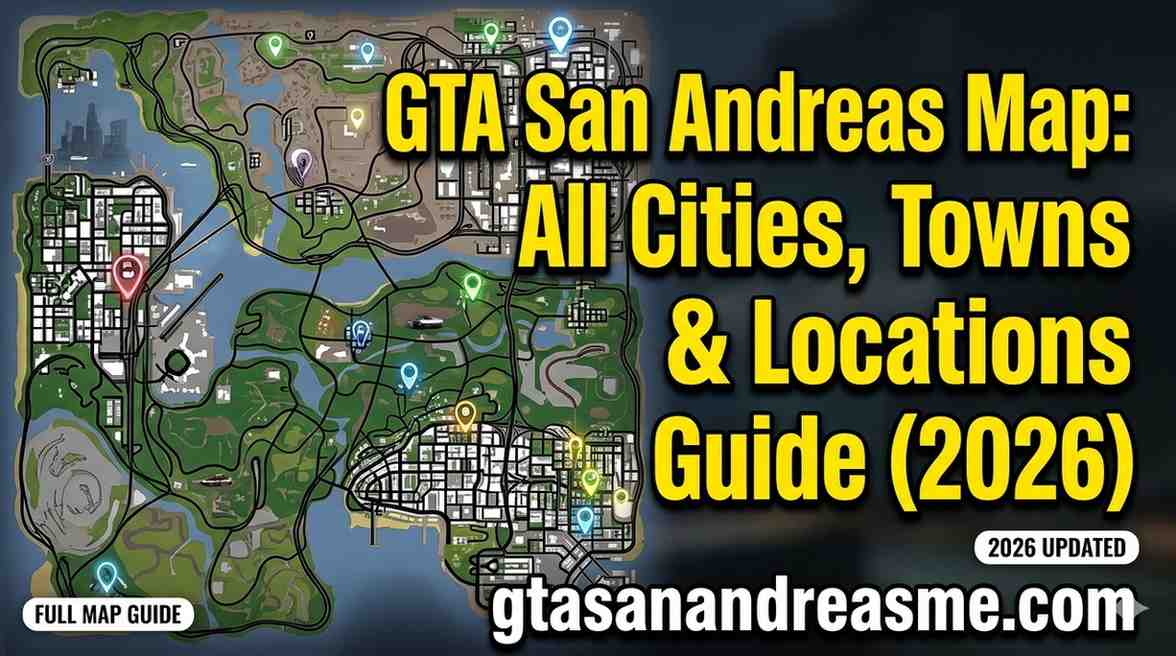
GTA San Andreas Map: All Cities, Towns & Locations Guide (2026)
Getting lost in GTA San Andreas is practically a rite of passage. The first time I drove out of Los Santos toward the countryside, I had no clue where I was headed. The fog rolled in, the road narrowed, and suddenly I was halfway up Mount Chiliad in the dark. That kind of organic discovery is exactly what makes this map special, even two decades after release. GTA San Andreas was developed by Rockstar North and remains one of the best selling games in history.
San Andreas puts three full cities, five countryside counties, 250 collectibles, and over 70 named locations into a single 38.2 square kilometer world. This guide covers every area worth knowing: what it looks like in real life, what you will actually find there, and what missions or collectibles tie to each location.
GTA San Andreas Map Overview
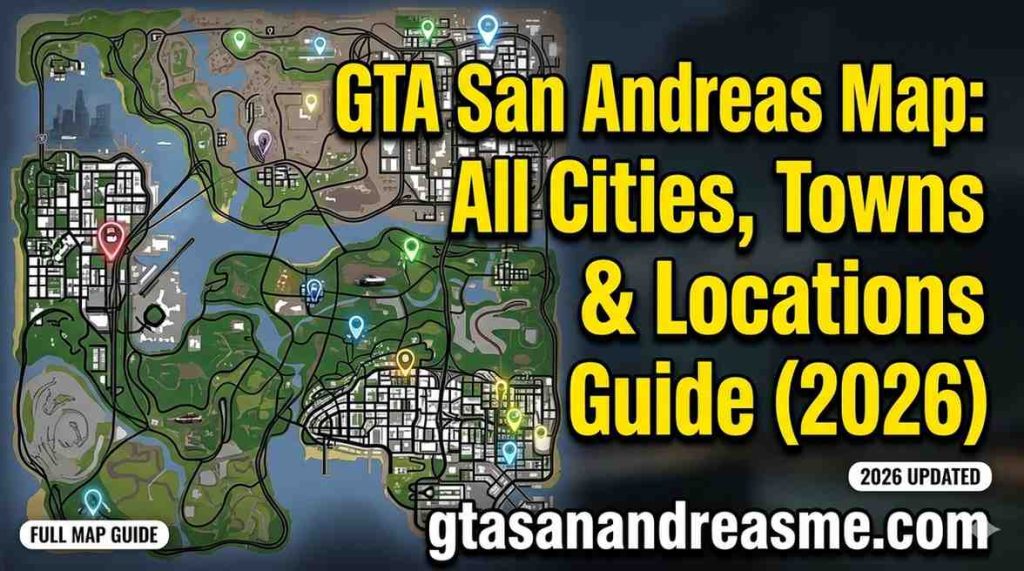
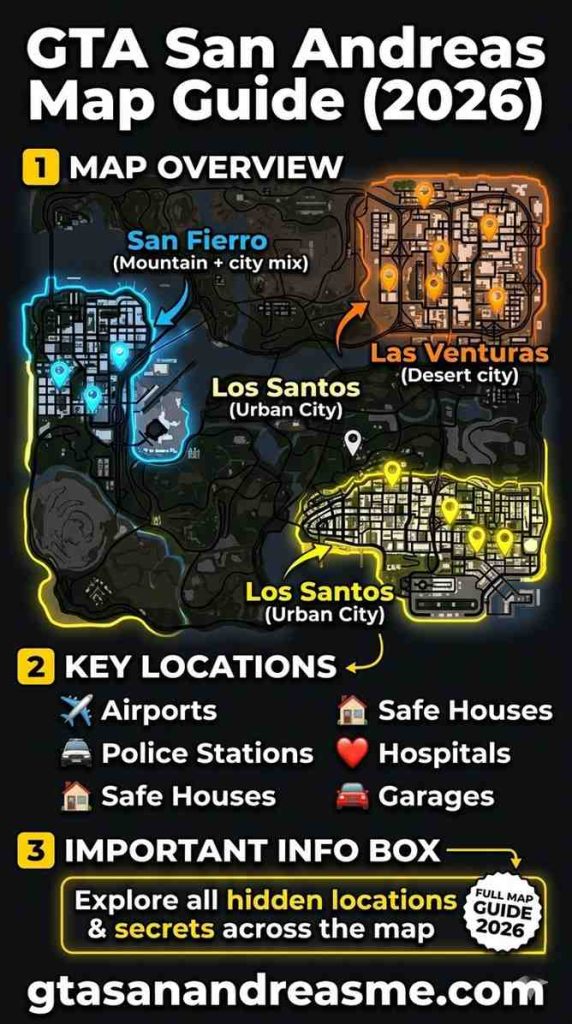
The map is a single connected world split into three cities and five countryside counties. You start locked into Los Santos, unlock San Fierro after completing the early story missions, and reach Las Venturas once the San Fierro arc wraps up. The countryside fills everything in between.
🗺️ Explore GTA San Andreas Interactive Map
Click the button below to open the full interactive map — find all weapons, safehouses, collectibles & missions.
🗺️ Open Interactive MapOpens in new tab — Full map with all locations
| Feature | Details |
|---|---|
| Total Map Area | 38.2 km² (14.75 square miles) |
| Major Cities | 3 – Los Santos, San Fierro, Las Venturas |
| Counties | 5 – Red, Flint, Whetstone, Bone, Tierra Robada |
| Total Collectibles | 250 items across all regions |
| Named Locations | 70+ distinct areas |
| Game Setting | 1992, fictional state based on California and Nevada |
| Highest Point | Mount Chiliad, Whetstone 800 meters |
When San Andreas launched in 2004, 38 square kilometers made it the biggest GTA map ever built. GTA V later surpassed it at roughly 127 square kilometers, but San Andreas still holds up because of how different each area feels from the next. No two counties look or play the same.
You can travel between cities using planes stolen from any of the three airports. Los Santos International, Easter Bay Airport in San Fierro, and Las Venturas Airport all have aircraft sitting on the tarmac.
If you want to experience GTA San Andreas with upgraded graphics and modern controls, check out the GTA San Andreas Definitive Edition.
GTA San Andreas Map: The Three Main Cities
GTA San Andreas has three main cities: Los Santos, San Fierro, and Las Venturas. Each city is inspired by a real American city and offers a completely different environment, culture, and set of missions.
Los Santos — Inspired by Los Angeles, California
Los Santos is the first city you explore in GTA San Andreas. CJ grows up here and it is the home of the Grove Street Families gang. The city captures the look and feel of early 1990s Los Angeles with gang wars, sunny weather, beaches, and luxury neighborhoods.
Central Los Santos
Commerce — Inspired by the Civic Center of Los Angeles. This area contains jails, courts, and government buildings.
Downtown Los Santos — Inspired by Downtown Los Angeles. The main business district of the city with tall skyscrapers.
Los Santos Convention Center — Inspired by the Los Angeles Convention Center. A large event venue in the heart of the city.
Mulholland Intersection — Inspired by the Four Level Interchange in Los Angeles. One of the most complex highway intersections in America and in the game.
Pershing Square— Inspired by Pershing Square in Los Angeles. A public plaza located in downtown Los Santos.
Verdant Bluffs— Inspired by Griffith Park in Los Angeles. A hillside area that overlooks the entire city.
West Los Santos
West LS is where the money lives. Beverly Hills, Hollywood, and Santa Monica all have counterparts here. The streets are cleaner, the cars are nicer, and gang activity drops noticeably compared to East LS.
Mulholland — Inspired by Hollywood Hills in Los Angeles. An expensive hillside area with large mansions and stunning city views.
Richman — Inspired by Bel Air in Los Angeles. One of the wealthiest neighborhoods in Los Santos with luxury homes.
Rodeo — Inspired by Beverly Hills in Los Angeles. A high-end shopping district with luxury stores and expensive cars on every street.
Santa Maria Beach — Inspired by Santa Monica Beach in Los Angeles. A beautiful coastal area with a boardwalk, pier, and beach activities for players to enjoy.
Vinewood — Inspired by Hollywood in Los Angeles. Home to the famous Vinewood Sign and the entertainment industry of Los Santos.
East Los Santos
East LS is working class territory. This is where most of the gang activity happens, where CJ’s grew up, and where the majority of early story missions take place. The streets feel rougher, the buildings are older, and you will spend a lot of time here before the game opens up.
East Beach — Inspired by Long Beach and the Beach Cities of Los Angeles. A coastal neighborhood near the shoreline.
El Corona — Inspired by Lennox and Pico-Union in Los Angeles. A Hispanic neighborhood and the territory of the Vagos gang.
Ganton — Inspired by Compton in Los Angeles. This is CJ’s home neighborhood and the base of the Grove Street Families gang.
Glen Park — Inspired by Echo Park and MacArthur Park in Los Angeles. A park area that serves as a major gang conflict zone in the story.
Idlewood — Inspired by Inglewood in Los Angeles. A residential gang neighborhood with heavy criminal activity.
Jefferson — Inspired by Watts in Los Angeles. A low-income area with strong gang presence throughout the story.
Las Colinas — Inspired by Northeast Los Angeles. A hillside residential area with mixed neighborhoods.
Little Mexico — Inspired by Olvera Street in Los Angeles. Known for its Mexican culture, food stalls, and street life.
Los Flores — Inspired by Boyle Heights in Los Angeles. A Hispanic working-class neighborhood in the east side of Los Santos.
Playa del Seville — Inspired by San Pedro and Harbor City in Los Angeles. A harbor-side neighborhood and home to the Seville Boulevard Families gang.
Willowfield — Inspired by Wilmington and Willowbrook in Los Angeles. An industrial area located close to the docks.
South Los Santos
Los Santos International Airport — Inspired by Los Angeles International Airport (LAX). The main airport serving the city of Los Santos.
Ocean Docks — Inspired by the Port of Los Angeles. A large industrial docking area used in several story missions.
The 100 Spray Tags for Los Santos are scattered across all of these neighborhoods. Start spraying early since the weapons reward unlocks at CJ’s house on Grove Street once you hit all 100.
San Fierro — Inspired by San Francisco, California
San Fierro is the second city unlocked in GTA San Andreas. It is known for its steep hills, fog, bridges, and diverse neighborhoods. The city closely mirrors the real layout and culture of San Francisco.
Avispa Country Club — Inspired by the Cliff House and the Olympic Club in San Francisco. An upscale country club on the western edge of the city.
Battery Point — Inspired by Fort Point in San Francisco. A historic area located near the water at the base of the Gant Bridge.
Calton Heights — Inspired by Pacific Heights in San Francisco. A wealthy hillside neighborhood with expensive properties.
City Hall — Inspired by the City Hall and Civic Center of San Francisco. The government and administrative center of San Fierro.
Corvin Stadium — Inspired by Candlestick Park in San Francisco. A large sports stadium located in the southern part of the city.
Cranberry Station — Inspired by the Caltrain Depot in San Francisco. A railway station used for transport across the region.
Doherty — Inspired by Dogpatch in San Francisco. An industrial district and the location of CJ’s garage and car business after the countryside missions.
Downtown and Financial — Inspired by the Financial District of San Francisco. The business hub of San Fierro with banks, offices, and tall buildings.
Easter Basin — Inspired by China Basin and Hunters Point in San Francisco. An industrial docking area with shipping containers and warehouses.
Easter Bay Airport — Inspired by San Francisco International Airport. The main airport serving San Fierro.
Esplanade East — Inspired by the Embarcadero in San Francisco. A waterfront area along the bay with pier access.
Esplanade North— Inspired by Fisherman’s Wharf in San Francisco. A tourist-friendly waterfront area with shops and restaurants.
Foster Valley — Inspired by Foster City, Burlingame, Silicon Valley, and South San Francisco. A suburban area south of the main city.
Gant Bridge — Inspired by the Golden Gate Bridge in San Francisco. This is the most iconic landmark in San Fierro and connects the city to the countryside.
Garcia — Inspired by The Mission and Potrero Hill in San Francisco. A Hispanic working-class neighborhood with street life and gang activity.
Garver Bridge — Inspired by the San Francisco-Oakland Bay Bridge. A large bridge connecting San Fierro to the eastern part of the map.
Hashbury — Inspired by Haight-Ashbury in San Francisco. Known for its hippie culture. This is where the character The Truth lives.
Juniper Hill — Inspired by Russian Hill and Nob Hill in San Francisco. A steep hillside residential area with great city views.
Juniper Hollow — Inspired by Cow Hollow in San Francisco. A quiet residential neighborhood near the waterfront.
Kings — Inspired by Noe Valley in San Francisco. A neighborhood area in the southern part of San Fierro.
Missionary Hill — Inspired by Mount Sutro in San Francisco. The highest point in San Fierro with panoramic views of the entire city.
Ocean Flats — Inspired by Sunset and Ocean Beach in San Francisco. A coastal neighborhood on the western edge of the city.
Palisades — Inspired by Presidio Heights, Panhandle, and Sea Cliff in San Francisco. An upscale residential area near the bridge.
Paradiso — Inspired by The Presidio in San Francisco. A green and peaceful area near the Gant Bridge.
Queens — Inspired by The Castro in San Francisco. A distinctive neighborhood known for its unique character.
Santa Flora — Inspired by Twin Peaks and Santa Clara in San Francisco. A hillside residential area in the heart of San Fierro.
Las Venturas — Inspired by Las Vegas, Nevada
Blackfield — Inspired by the University District in Las Vegas. A residential and commercial area on the edge of the city.
Creek — Inspired by suburban neighborhoods around Las Vegas. A quiet area away from the casino lights.
Las Venturas Airport — Inspired by Harry Reid International Airport in Las Vegas. The main airport serving the desert city.
Linden Side — Inspired by industrial and residential zones of North Las Vegas. A working-class area with warehouses and factories.
Old Venturas Strip — Inspired by the Fremont Street Casino District in Las Vegas. An older and less glamorous gambling area compared to The Strip.
Pilgrim — Inspired by Chinatown Plaza in Las Vegas. A mixed commercial area in the city.
Prickle Pine — Inspired by Summerlin in Las Vegas. A suburban residential neighborhood on the outskirts of the city.
Redsands East — Inspired by the Las Vegas Arts District and Gateway District. A residential area on the eastern side of the city.
Redsands West — Inspired by North Las Vegas and the Cultural Corridor area. A desert residential neighborhood.
Roca Escalante — Inspired by the Downtown Financial District of Las Vegas. A commercial and residential area near the casino zone.
Rockshore East — Inspired by Whitney in Las Vegas. A working-class neighborhood on the eastern outskirts.
Rockshore West — Inspired by Henderson in Las Vegas. A suburban area on the western side of the city.
Spinybed — Inspired by Sunrise Manor in Las Vegas. A residential neighborhood away from the main casino area.
The Strip — Inspired by the Las Vegas Strip. The most famous road in Las Venturas lined with bright casino lights, luxury hotels, and nonstop entertainment.
Whitewood Estates — Inspired by the Westside area of Las Vegas. A quiet residential neighborhood in Las Venturas.
GTA San Andreas Map: Countryside and Desert Regions
Beyond the three cities, GTA San Andreas has five countryside counties filled with forests, mountains, desert, and small towns. These areas offer a completely different experience from the urban environments.
Red County — Inspired by the Inland Empire and San Bernardino County, California. A rural farming area located between Los Santos and San Fierro. Known for winding country roads and small farming communities.
Palomino Creek — Located on the eastern side of Red County with residential areas and a river nearby.
Montgomery — The largest town in Red County located in the central part of the area.
Dillimore — Known for its gas station and sheriff’s office. A small working-class town.
Blueberry — A farming community with grain silos and a small industrial area surrounded by farmland.
Flint County — Inspired by rural Northern California. A heavily forested area with no major towns. Features lumber mills, rolling hills, and scenic country roads.
Whetstone — Inspired by the Sierra Nevada foothills of California. A mountainous area dominated by Mount Chiliad, the tallest peak in the entire game at 800 meters.
Mount Chiliad — The most iconic landmark in the countryside. Players can mountain bike down its trails and enjoy spectacular views from the top.
Angel Pine — A small quiet town located at the base of Mount Chiliad with local shops and a medical center.
Bone County — Inspired by the Mojave Desert of California and Nevada. A dry barren desert region located between Las Venturas and San Fierro.
Verdant Meadows — An abandoned airstrip later owned by CJ. Used for flight training and air missions throughout the story.
Area 69 — Inspired by Area 51 in Nevada. A highly secured military base that players raid during story missions.
Las Brujas — A ghost town with abandoned buildings in the middle of the desert.
El Castillo del Diablo — A prominent rock formation in the desert near Las Brujas. A popular exploration spot for players.
Tierra Robada — Inspired by Central California coastal areas. A dry desert region with high cliffs, small towns, and dusty roads in the northwest near Las Venturas.
Bayside — A small coastal town with a marina and boat school located at the northeastern tip of Tierra Robada.
Robada Intersection — A major road that links Tierra Robada with Bone County and Las Venturas.
Sherman Dam — Inspired by Hoover Dam on the Nevada and Arizona border. The most impressive man-made structure in the game, used in several story missions.
All GTA San Andreas Collectibles: Locations and Rewards
There are 250 total collectibles spread across the map. Collecting all of them contributes to 100% completion. Here is the full breakdown by type, location, and reward.
| Collectible | Total | Where Found | Reward |
|---|---|---|---|
| Spray Tags | 100 | Los Santos only all districts | Weapons spawn at Johnson House |
| Snapshots | 50 | San Fierro only all districts | $100,000 + weapons at Doherty Garage |
| Horseshoes | 50 | Las Venturas + Bone County | $100,000 + weapons at Four Dragons Casino |
| Oysters | 50 | Underwater statewide (all regions) | Max lung capacity + $100,000 |
Collectible Strategy Tips
After spending time hunting all 250 items across multiple play throughs, these approaches save the most time.
- Spray Tags first. They are available from the very start of the game and reward you with weapons that help in early missions.
- Use an interactive map from MapGenie.io or GTA-SanAndreas.com. Paper maps and memory are not sufficient across 38 square kilometers.
- Complete the Black Project mission in Bone County before hunting horseshoes. The Jet pack it unlocks makes reaching elevated casino locations much faster.
- Build lung capacity before going after oysters. Repeated shallow diving increases your underwater time naturally. Start on shallow oysters near Santa Maria Beach.
- Work region by region for snapshots. San Fierro’s steep hills and fog make the district-by-district approach far more efficient than roaming.
- Horseshoes and the Bone County oysters near Area 69 are the hardest to reach. Plan those deliberately rather than stumbling on them.
GTA San Andreas Interactive Maps: Best Resources
Static paper maps worked fine in 2004 when the game was new. Today, interactive maps with check boxes and filtering are far better tools for completionist runs. Here are the most reliable resources available.
| Resource | Best For | Tracking |
|---|---|---|
| MapGenie.io | All collectible types, mobile-friendly interface | Yes! Checkbox system |
| GTA-SanAndreas.com | Detailed screenshots + interactive overlays | Yes! Per item |
| IGN Interactive Map | Weapons, vehicles, properties, missions | Partial |
| GTASnP.com | Import your save file to see completion gaps | Full save tracking |
GTASnP.com deserves a special mention. You can upload your actual save file and it maps every collectible you have and have not collected yet. Far more accurate than trying to track manually.
How to Unlock the Full San Andreas Map
The map unlocks in stages tied to story progression. Trying to enter locked areas early results in a 4-star wanted level and police chasing you out. The progression is as follows.
| City / Region | Unlocked By | Mission Name |
|---|---|---|
| Los Santos + Red County | Game start | Available immediately |
| Flint County + Whetstone | Progress through LS missions | Countryside access opens mid-game |
| San Fierro | Complete Los Santos arc | “Badlands” mission |
| Las Venturas + Bone County | Complete San Fierro arc | “Yay Ka-Boom-Boom” mission |
| Tierra Robada | Las Venturas unlocks | Opens with LV progression |
Some players try to swim or fly into locked areas early. It is possible but not recommended. The wanted level makes it chaotic and you cannot save in those areas. The game is structured to give you each city when the story is ready for it.
Getting Around San Andreas: Transportation and Airports
Airports
| Airport | City | Key Features |
|---|---|---|
| Los Santos International | Los Santos South | Largest facility, commercial traffic, most aircraft types available |
| Easter Bay Airport | San Fierro West | Medium-sized, easier to access, less security activity |
| Las Venturas Airport | Las Venturas North | Desert location, connects to Bone County, good aircraft selection |
| Verdant Meadows | Bone County | Player-owned after purchase, personal hangar, flight school location |
Rail Network
- The Brown Streak Railroad runs freight train routes connecting all three cities.
- Passenger stations exist in Los Santos, San Fierro, and Las Venturas.
- Train cars are explorable and the trains can be commandeered.
- The freight train mission is one of the more memorable early game sequences.
Highway System
- Interstate-style highways connect the three cities with good high-speed routes.
- County roads wind through Red County, Flint County, and Whetstone.
- Desert highways cross Bone County with long straight stretches ideal for fast vehicles.
- Mountain passes cut through Whetstone with challenging elevation changes.
- Coastal highways run along the ocean south of Los Santos and northwest toward San Fierro.
Hidden and Unique Locations Worth Finding
San Andreas is full of places that do not show up on missions but reward you for finding them. Here are the ones that genuinely surprised me on first discovery.
Easter Eggs and Developer Secrets
- The ghost car in Back o Beyond: A vehicle that appears to roll down a hill without a driver. It is not actually supernatural (it is a physics quirk with a parked car on a slope) but it became a major community legend in 2004.
- The Wheelchair in Palomino Creek: An empty wheelchair sitting on a rooftop with no explanation. Still referenced by the community twenty years later.
- Chiliad Myth murals: Paintings inside the Mount Chiliad observation shack that Rockstar later expanded into a full mystery in GTA V. Worth visiting if you know the GTA V mountain.
- The San Andreas Fault seabed: A visible fault line runs along the bottom of San Fierro Bay, directly referencing the real San Andreas Fault that the state is named after.
- The Epsilon Cult billboards: Early references to the cult that appears prominently in GTA V.
Unique Stunt Jump Locations
There are 70 unique stunt jumps spread across the map. Completing them all is not required for 100% but completing 25 of them is a mission requirement. The best stunt jump density is in Los Santos, particularly around the downtown freeway interchanges and Ocean Docks. Las Venturas has several jumps on casino rooftops.
What the San Andreas Map Gets Right and Where It Falls Short
What Works Well
- The variety across three cities and five counties keeps the world feeling fresh throughout a 40 to 60 hour play through. Driving from Los Santos to Las Venturas actually feels like a road trip.
- Each region has its own visual identity. You always know roughly where you are just from looking at the environment.
- Hidden collectibles and easter eggs reward thorough exploration beyond the main story. The world has depth beyond missions.
- The countryside sections provide genuine pacing relief between intense urban missions. The quieter moments in Whetstone or Flint County make the city chaos feel more impactful.
- The map was designed without GPS, which forced players to learn routes organically. That knowledge becomes genuinely satisfying to develop.
Where It Falls Short
- Without GPS in the early game, navigation in unfamiliar counties can be genuinely frustrating. The radar helps but countryside roads look similar without landmarks.
- Collecting 250 items across 38 square kilometers requires significant time investment. Without a proper interactive map and tracking system, missing one tag in Los Santos means rescanning the entire city.
- The story-gated map unlocking prevents free exploration. Getting a 4-star wanted level for wandering too far north in the early game is jarring.
- Travel time between cities is considerable. Stealing a plane is usually necessary rather than optional for players who want to move efficiently.
Final Thoughts on the San Andreas Map
GTA San Andreas Mod APK built something that holds up because the map was designed with intention. Three cities that feel genuinely different. Five counties that each have a distinct purpose and character. A collection of hidden locations, easter eggs, and secrets that rewarded players who went off the beaten path.
The gang streets of Ganton, the foggy hills of San Fierro, the neon excess of Las Venturas, the silent desert of Bone County, and the ghost towns scattered in between all feel like they belong to the same world while looking nothing alike. That variety across 38 square kilometers is the reason people still come back to this game twenty years after release.
Grab an interactive map, pick a region, and start exploring. You will find something worth seeing in every corner of the state. Grove Street. Home. At least it was before all this started.